

Branches in seconds
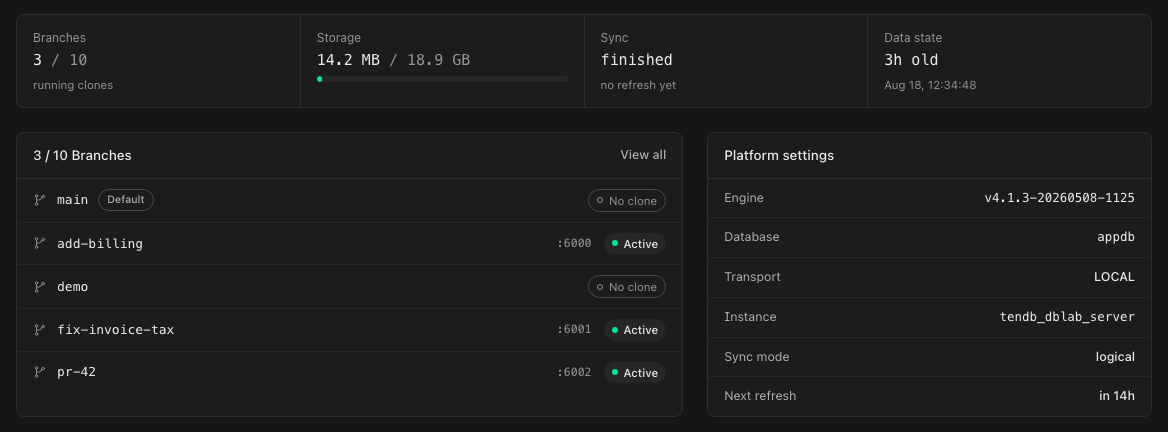
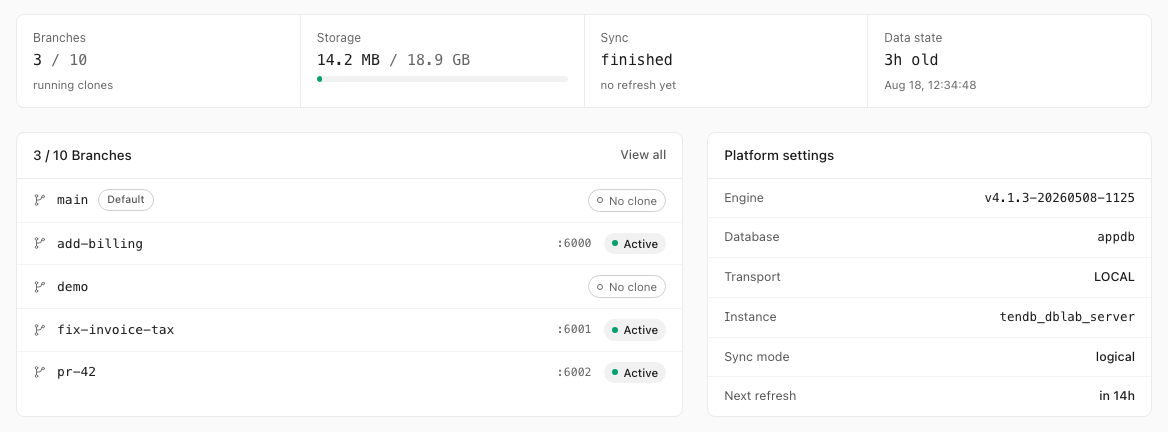
Every branch is a ZFS copy-on-write clone of your synced data — a real, writable Postgres that costs only the pages you change. Create it, break it, delete it.
npx @10play/tendb init # scaffold the infra into your projecttendb up # terraform apply + config wiringtendb branches create my-feature # copy-on-write branch DB, ready in ~5stendb ci ensure 42 | tail -1 # CI: connection URI as the last stdout lineBranches in seconds
Every branch is a ZFS copy-on-write clone of your synced data — a real, writable Postgres that costs only the pages you change. Create it, break it, delete it.
Infrastructure you own
tendb init scaffolds the Terraform, tendb up applies it — one host in
your AWS, GCP, or Azure account, or Docker on your laptop. No SaaS, no
control plane; your data never leaves your infrastructure.
CI preview databases
tendb ci ensure "$PR" | tail -1 prints a ready connection URI as the last
line of stdout. Idempotent on re-runs; cleanup on PR close succeeds even
when the platform is torn down.
Neon-style CLI and console
neonctl-style commands plus a local web console: branch tree, SQL
editor, schema browser, snapshots, per-branch monitoring, and Slack
alerts.
Locked down by default
No SSH, no inbound internet. Access rides each platform’s native tunnel — SSM on AWS, IAP on GCP, Bastion on Azure, loopback locally — and clone passwords are derived on demand, stored nowhere.
Any Postgres source
Sync from Neon, Aurora, RDS — anything with a postgres:// URL. The
source connection string lives in your platform’s secret store and is
read by the host at boot.
tendb stands on DBLab Engine by Postgres.ai — the open-source engine that does the heavy lifting of ZFS thin cloning and copy-on-write branch databases. tendb adds the platform packaging around it: Terraform provisioning for AWS/GCP/Azure/local, tunnel transports, the CLI, the web console, and the CI contract.